The girl in the swimming pool
It's magical to watch a girl begin to drown,
 suspended with her face towards the rain,
 then lift and place her gently on the ground
 and coax her lungs to believe and breathe again.

 Your dad had raced the tide, and fought his way
 through surf, on jagged granite, years before,
 to reach and rescue you from panicked spray
 and the pull of the sea, and swim you back to shore.

 You fancy higher powers had bid him save
 you, so you'd later rescue in her turn
 this girl half-floating on her enchanting wave
 who sank, and rose, and sank; a stricken bird –

 but when you lean out from the parapet
 above the shadowed gorge, where far below
 those blue and sightless swollen dolls forget,
 forget, forget, in time with the river, you know

 one life saved means no more nor less – beside
 whole families who cowered in stands of cane
 and, hopeless, queued in quiet lines to die –
 than one life saved: unlinked in any chain.


Published in the Kent & Sussex Folio, 2019
Poetry after Auschwitz
'Poetry is pointless – like kicking a stone’
 - overheard at a poetry reading

 At the start and the end of this long, straight road:
 a silent child, a house in flames,
 a leafless tree, an empty town

 He kicks a stone to watch it leap
 and skitter on the flattened clay,
 then slow and stall and go to ground

 Along the forest edge stand those
 he's failed to save: he sings his song;
 his unknown patrons hear no sound

 and yet he feels their silence deep
 beneath his feet, and sees beyond
 the tree, the child, the house, the town


Published in the Kent & Sussex Folio, 2019
Sunday
I.
In shade is cold. I face the railway bank.
Each fresh wet blade of lawn is trimmed.
Birdsong, a distant plane and muffled train
augment the silence. Topmost limbs
of the tallest oaks and sycamores are lit.
Coffee drifts from the dew-damp table.
A robin hops and pokes the shadowed soil
beneath the feather-leaf maple.
I name my flowers: foxglove, poppy, rose…
Dew pools like mercury, on watertight
nasturtium leaves. In measureless time, I find
the perfect rhyme, and summer light
begins to peel the coverlet of day,
slips effortlessly down the bank towards me
brightening, and creeps across the grass
to touch my feet; abruptly warms me…
II.
… From Sunday’s topical TV,
vox populi intrudes in drifts
of sound, insisting lazily
on infiltrating all the gifts
of silence, time and space I’ve nursed.
Its current casually blows
the floating phrases into verse –
though scarcely quickening their prose.
‘… So why should I work hard to pay
for them to sit around all day?’
‘The vulnerable need our care –
I’m more than proud to pay my share.’
‘They take us for a bunch of fools:
‘if they live here, they follow our rules.’
‘Well I, for one, just don’t subscribe
to the kind of Britain you describe.’
While claiming depth, each voice defines
itself in shallow tones as pro
or con – as though to part from lines
already drawn would be to throw
away the comfort of deceit
and live in panicked fear – and swells
with self-reflection to repeat
ideas which paraphrase themselves…
III.
… afraid of synthesis, we stand around
the tree which grew within the forest while
we looked away, and each in different style
describes the contours of its bole and crown,
the spiny fruits in which its seeds are found,
its leaves and inch-long thorns… And thus profile
the traits we see, but make no common trial
of whether it will heal or harm our ground.
Though God, alarmed by Nimrod’s tower, to tame
us gave each tribe a language only He
and they could speak, His trick was not to name
a multiplicity of tongues, but the
illusion that within a single tongue,
by sharing words, we share a lexicon.
First published by Ink Sweat & Tears, December 2018
Perverse
The day we learned the Earth was doomed –
five years until the end –
we talked and talked the whole night through
and talked it through again,
and conjured plans for how we’d weave
new patterns in the past,
to reinvent today and cleave
our future from its path –
but then fell quiet as dawn revealed,
through misted glass, blurred views
of rooftops, roads and distant fields
we knew, and knew we’d lose,
and morning light diminished day,
extinguishing our fight,
while fog set in to shroud and weigh
upon five years of night –
in which we peered, saw no reprieve
but jagged, fire lit forms,
and children cowed, down on their knees
at barricades of thorns.
The floor above us creaked – we shared
an awful thought – a glance;
a child’s soft foot fell on the stairs
and silence stopped our hearts.
We’ve planted trees, although we knew
they’d never be but young,
and raised our son and daughter to
be whom they might become.
Published: Firewords #11, 2018
Stabat Mater
She sank to her knees on the shaking ground
 when she reached the place.

 A thorn pierced her heart,
 as she raised her eyes
 from the foot of the cross,
 to her dying son.

 A mother’s pain.

 And we weep too,
 as though we were there.
 We see her shudder
 to share the deep-bone pain he bore for us.

 He died alone.

 Mother, let me too
 kneel down with you,
 bear all I can of all he bore,
 share in his love
 and in the path he pointed to.

 I know he felt those wounds and died for me –
 don’t push me away –
 mother, I need to feel this too:
 I need to know the meaning of this place.

 He died for us.

 Let me find my harbour in what happened in this place,
 let me find my harbour in your arms,
 and in his grace.
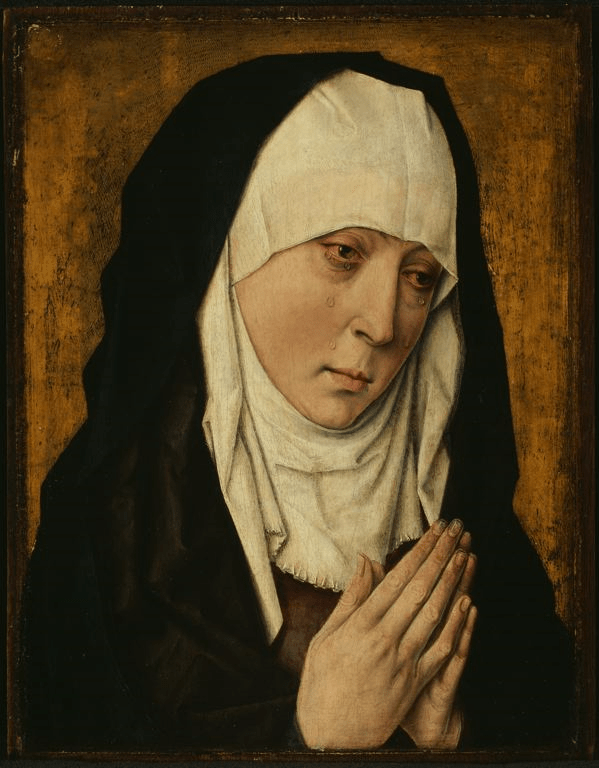
This update of the 13th Century Latin hymn Stabat Mater was set to music beautifully by Nicola Burnett Smith and first performed at St Paul’s, Covent Garden, London on 15th April, 2019. The recording can be heard here.
The Latin original, followed by a rough translation, follows.
Stabat Mater
Stabat mater dolorósa
juxta Crucem lacrimósa,
dum pendébat Fílius.
Cuius ánimam geméntem,
contristátam et doléntem
pertransívit gládius.
O quam tristis et afflícta
fuit illa benedícta,
mater Unigéniti!
Quae mœrébat et dolébat,
pia Mater, dum vidébat
nati pœnas ínclyti.
Quis est homo qui non fleret,
matrem Christi si vidéret
in tanto supplício?
Quis non posset contristári
Christi Matrem contemplári
doléntem cum Fílio?
Pro peccátis suæ gentis
vidit Iésum in torméntis,
et flagéllis súbditum.
Vidit suum dulcem Natum
moriéndo desolátum,
dum emísit spíritum.
Eja, Mater, fons amóris
me sentíre vim dolóris
fac, ut tecum lúgeam.
Fac, ut árdeat cor meum
in amándo Christum Deum
ut sibi compláceam.
Sancta Mater, istud agas,
crucifíxi fige plagas
cordi meo válide.
Tui Nati vulneráti,
tam dignáti pro me pati,
pœnas mecum dívide.
Fac me tecum pie flere,
crucifíxo condolére,
donec ego víxero.
Juxta Crucem tecum stare,
et me tibi sociáre
in planctu desídero.
Virgo vírginum præclára,
mihi iam non sis amára,
fac me tecum plángere.
Fac, ut portem Christi mortem,
passiónis fac consórtem,
et plagas recólere.
Fac me plagis vulnerári,
fac me Cruce inebriári,
et cruóre Fílii.
Flammis ne urar succénsus,
per te, Virgo, sim defénsus
in die iudícii.
Christe, cum sit hinc exíre,
da per Matrem me veníre
ad palmam victóriæ.
Quando corpus moriétur,
fac, ut ánimæ donétur
paradísi glória. Amen.
Rough translation, adapted from https://www.stabatmater.info/
The grieving Mother stood weeping beside the cross where her Son was hanging. Compassionate and grieving, a sword passed through her weeping soul. How sad and distressed was that blessed Mother of the Only-begotten, who mourned and grieved and trembled at the torment of her glorious Child.
Who would not weep, seeing the Mother of Christ in such agony? Who would not feel compassion on beholding Christ’s Mother suffering with her Son? For the sins of His people she saw Jesus in torment, scourged. She saw her sweet child dying, forsaken, while He gave up his spirit.
O Mother, fountain of love, make me feel the power of sorrow, so I can grieve with you. Grant that my heart may burn in the love of Christ my Lord, that I may please Him. Holy Mother, grant that the wounds of the Crucified drive deep into my heart. Share with me the agony of your wounded Son, who so deigned to suffer for me. Let me sincerely weep with you, bemoan the Crucified, as long as I live. I desire to stand beside the cross with you, and gladly share the weeping. Chosen Virgin of virgins, do not be bitter with me, let me weep with you. Grant that I may bear the death of Christ, the fate of his Passion, and commemorate His wounds. Let me be wounded by his wounds, made drunk by the cross because of my love for the Son.
Defend me, O Virgin, lest I burn in the flames of hell on the day of judgement. Christ, when it is time to pass away, grant that through your Mother I may come to the palm of victory. When my body dies, grant that the glory of paradise is given to my soul. Amen
What happened?
Had he discovered Christ’s essential truth
when Luther nailed his theses to the door;
did Einstein’s never-ending search for proof
elucidate a universal law;
or was it humble happenstance that saw
us tell their counting beads to gauge our worth?
Can gilding tales of nightly siege and war
they knew, dissolve our children’s ingrained hurt?
Historians, parents, demagogues, the church,
our mischievous and guardian selves, TV…
make sense of all that’s passed, on our behalf
but – never mind how well they choose their words –
by naming, they distort the shapes they see
and blur the backlit veil on which they’re cast.
First published in Pennine Platform no. 84
Remarks delivered at a lunchtime event on inclusive peacebuilding organised by the Commonwealth Parliamentary Association, UK branch, at the Palace of Westminster 2 April, 2019 – and also on the CPA-UK’s website
Inclusive Peacebuilding
Conflict is not in itself bad. Indeed, without conflict – differences of vision, perspective and interest, and the competition over ideas– it’s hard to see how we could make much progress in human society. What’s bad however, is when conflict is unmanaged and unresolved, and becomes violent.
Levels of violence are on the rise, as shown by news headlines and the recent and current experiences of far too many children, women and men around the world. The annual Global Peace Index score has consistently got worse from year to year in the past decade. So we clearly need more inclusive peacebuilding.
Peacebuilding is the collective term for the many different ways in which people and institutions try to achieve two goals. First, prevent, minimise or stop the violence. If successful, this may create what’s sometimes known as a ‘negative peace’ – i.e. where people aren’t harming one another, but the conflicts – or at least their underlying causes – remain unresolved, with a risk of further frustration and violence in the future.
The second goal of peacebuilding is therefore ‘positive peace’ – the ability of societies to anticipate, manage and resolve conflicts, based on the availability of functional, open and trusting relationships between people and peoples, and between citizens and the institutions and people with power to make decisions that affect them. These are sometimes known as horizontal and vertical relationships, respectively. When these relationships work well, they are both the cause and the result of people’s fair access to a series of essential public goods: decision making and accountability processes, economic opportunity, education and health and other services, justice, and security. An inclusive peace is one in which people – and recognisable groups in society – feel they have fair access to those things, and are therefore included, not excluded. Being included, they have opportunities, not grievances. And inclusive peacebuilding refers to peacebuilding processes that enable fair outcomes, through processes that are in themselves as inclusive as possible, given the circumstances – i.e. they too are fair.
Why this matters to the Commonwealth
There are several reasons why this matters to the people and institutions of the Commonwealth. First, it should matter to us all morally, that people are suffering from violence. That is one reason why the Sustainable Development Goals include a global commitment to building peace. Peace is also part of the raison d’être of the Commonwealth, mentioned almost at the top of the Charter, which in its second line refers to the problems created by living through ‘an era of …. unprecedented threats to peace and security’. The Commonwealth commissioned Amartya Sen to write Peace and Democratic Society in 2011, drawing on Civil Paths to Peace, a core Commonwealth text.
Some Commonwealth countries are clearly affected by active or unresolved conflicts: Bangladesh, Cameroon, Cyprus, Fiji, India, Kenya Pakistan, Lesotho, Nigeria, Rwanda, Sierra Leone, South Africa, Sri Lanka and Uganda come most readily to mind. But others are situated in so-called ‘bad neighbourhoods’ – places where conflicts can spill readily over the border from non-Commonwealth countries. Others are affected by chronic gang violence linked to crime and politics. Others, still, are affected by the nasty strain of populism currently spreading across the world, including in some of the apparently more ‘advanced’ democracies, and by the threat of various forms of violence linked to extreme politics, including terrorism. What happened in New Zealand recently was enough to remind us that nowhere is really safe from conflict. And many Commonwealth countries are also threatened by Islamic extremist terror.
Everyone is a potential peacebuilder
Relatively few people and institutions see themselves as ‘peacebuilders’. Certainly far too few to resolve all the world’s conflicts, if we were to rely only on them. Fortunately, however, all of us can contribute to peace. Many of us already are, even if we don’t quite see it like that. That’s because anyone who has an impact on the nature of the public goods referred to earlier, has the capacity to make them either fairer, or less fair, i.e. better or worse, for peace: economic opportunities, decision-making and accountability processes, education, health and other services, justice, and security…
What this means is that all political and technical actors and agencies working on such issues – whether their role is primarily a political or technical one – need to set peacebuilding goals, alongside their other goals. They need to ask themselves: how can we implement our role, in a way that makes peace stronger and more durable?
Economics and peace
Let’s take a look at the question of economic access, for example. The European Union is widely recognised as a peacebuilding project – on a vast scale. And yet its origins were in the (comparatively) humble Iron and Coal Communities, established by leaders who sought to combine key economic sectors in France and Germany, and thus neutralise the apparent interest of either, in going to war with the other. Whether that makes it an economic project with a peacebuilding goal, or a peacebuilding project with economic goals, partly depends on your politics, and may not matter. In either case, it’s classic example of how economic policy decisions can be harnessed to peacebuilding goals. Other intergovernmental economic blocs can do the same: look at their neighbourhood, identify the risks of violent conflict, and work out economic policies to reduce them, and include these in regional agreements and ways of working together. Even if this means foregoing some economic benefit in the short term. I think all Commonwealth countries are members of one or more such regional blocs.
Governments can and should of course do the same within their own borders, for example setting stability and peace goals, and using these, alongside GDP, defence, poverty eradication, etc., to define and gauge the effectiveness of their policies and programmes. Kenya, to take an example, can consider economic policies that enable better job creation in communities vulnerable to the blandishments of Al Shabab’s recruiters, so that young people are less likely to be attracted to violence. Banking policy can insist – as the government has done in Peru – that all major bank / investment loans are based not just on a financial case and an environmental impact assessment, but also on a social assessment, asking whether the project will be good for social cohesion, or divisive, and refusing the invest in the latter. Governments help set the tone for societal discourse, so they also need to be publicly explicit about their peace and stability goals, in explaining the decisions they make, so citizens understand why – for example – public funds have been applied to what might seem ‘uneconomic’ investments. President Nyerere of Tanzania perhaps set us a good example when he focused his presidency on creating a stable, unified Tanzania out of many tribes and lanscapes, rather than going for the fastest economic growth.
Businesses are of course very important economic players, and they can contribute hugely to inclusive peace if they set their minds to it. Like governments, businesses should set peacebuilding goals, alongside their production and financial goals, and these need to be tailored to the needs and opportunities specific to their business and context. In a divided, multi-ethnic context, they might set out to employ people from both ethnic groups, and foster workplace harmony that employees can take home with them, as some companies have done. They might also look at their supply chain and make sure that they purchase as much local content as possible, and ensure their procurement is done fairly, to maximise their contribution to local stability. They might take extra steps to follow the letter of the law when it comes to gaining access to land or other resources, even when local practices might encourage cutting corners, as this might help reinforce good governance practices….
And of course donors and other international organisations, which can have an influential role in fragile contexts, need to make sure that their economic projects and initiatives are conflict-sensitive, contributing to both peace and economic growth. If large numbers of jobs are needed, to maintain the peace, then donors may need to drop the orthodoxy of recent times, in which ‘the private sector must provide’, and go back to a simpler model whereby external transfers are used to subsidise labour intensive public infrastructure for perhaps 2-3 generations, while the economy reaches the capacity needed to provide enough jobs and business opportunities.
Something for us all
These are just a few examples, and all peacebuilding has to be context-defined, first and foremost: there are few prescriptions. The key take away, I think, is that inclusive peacebuilding should not be left to the self-avowed peacebuilders. It’s something for us all, and that includes business people and others with an economic sector role.
Hostage
I practise holding still as settled sand,
although my heartbeat’s caving in so fast
I barely hear the voice, nor feel the hand
directing me to lift the blindfold and
advance towards the knot of waiting cars.
I practise mentally how I will kneel
and face the world – face you – with dignity;
imagine how the slicing blade will feel…
if I’ll succumb to crumbling consciousness,
to crippling fear, or simple agony?
I practise holding both hands in the air
and calling out my name when armed men storm
the door, obeying their commands as glare
from sudden sunlight slants through dust and din,
and certain hands propel me from the room.
I practise holding out my arms to you
as wide as any tranquil summer sea,
when ransom or rescue returns me to
the shore my trespasses had wrenched me from,
and picture you forgiving me.
But mostly I rehearse the smallest moments:
Sunday walks, the pier, the tree we climbed;
the neighbours’ girl; the wheeling starlings – omens,
surely, even then, I’d disenchant
our world and discombine the layers of time.
The cliffs, the wheeling starlings: omens, yes.
But what I did to her – to you – I did.
You know my darkness now: only my death
could free you to remember me again,
but will not free you – free her – to forgive.
Published in Earlyworks 2018 anthology
Interpreting
We had little to do at first
except avoiding one another’s eye
with manufactured hurt –
as one of the Russians (quietly) remarked:
translating stony silences
is harder than you’d think.
When Khrushchev demanded Ike apologise
for what was practically an act of war
Ike made like nothing had been said –
though we’d all heard it had,
and I’d repeated it
so I was sure.
But Khrushchev wouldn’t let it go:
it was yet more proof he couldn’t trust the West,
so what was the point of this?
Then Ike said we’d had no choice
because we can’t trust you –
and so the summit went:
an injured silence interspersed with versions of
it’s all your fault,
until the Soviets said that’s that and quit the room
and Paris, too.
I heard all both sides said out loud –
said half of it myself, in fact –
but cannot say if either asked himself
how his opponent felt, nor how
to help him help make this all right.
Published in a Hedgehog Press Stickleback edition
Percentages
At first, they glanced, and glanced again, before
each knew the way to ask, and to respond;
and as their confidences grew, each saw
the other’s gap of love, and far beyond,
and learned, like breathing out and in, to sense
and meet the other’s needs; and thus their own.
But now, in relearned doubt and coy pretence
a new-found germ of awkwardness has grown.
Back then, it was enough to hint desire
for her (or him), to know, nine times in ten,
that she (or he) would correspond in kind.
Today, as each more rarely feels inspired
the odds are merely vanishing, that when
one sings of love, the other’s lines will rhyme.
Published in a Hedgehog Press Stickleback edition

