Ceasefire
Ceasefire

When the lake is pewter, like today,
reflecting leafless trees,
russet, bracken hills,
and a motionless cloud,
we look to the west,
from where the weather comes,

where winds will gather again
to rain in sheets incessantly
and drive wave after wave
to batter and wrench the meadow’s edge,
uproot these leaning willows or
surround and cut them off from shore.
The Command
This poem, inspired by a visit to the site of the 1919 massacre in Amritsar, and also referencing the Troubles in Northern Ireland, Peterloo and Tienanmen Square, and with an epigram from Rwanda, is in my collection Guerrilla Country (Flight of the Dragonfly, 2024).
The command
‘An order is heavier than a stone.’

The magistrate, for fear
his fear will come to pass,
sends formal notes to regiments.

The chief of police, sure they
wish bloodshed over peace,
calls out the words that make it so.

The soldier puts in play his plan
to teach these people
what he understands.

***

A simple mark,
a sound or gesture
sets in motion—everything.

Block exit gates with bayonets.
Cut through the crowd.
Fire tear gas, baton, then live rounds

above their heads—
then lower. Aim at where
the densest groupings are.

Don’t shrink—redouble your resolve
when they begin to flee.
Send in the tanks.

***

Inside,
the image of the golden sanctum
barely shimmers,

pilgrims walk in silent circles,
heel to toe, around
the sarovar.

***

How certain must they be,
who utter these commands,
the stage they stand upon

and laud and idolise
is crumbling in the sea?
Where do their shadows go?

And where do ours,
who fail to prevent
their words?
After the forest fire
After the forest fire

Because we were four
and I only had strength to carry one
and knew no other way
I carried the one who called out loudest;
threatened us most.

You two were left to walk behind
in the dust of hot, dry summer and
the heavy mud of winter and spring.
Perhaps I thought you’d learn the land –
more likely, I just hoped we’d be OK.

That morning found us silent, slumped
among the charred remains of trees.
The flames, too, were spent after such a night.
But the undersoil still burned, untraceably,
towards where uncharred trees remained.
Social engineering
Social engineering

For desert dunes it’s 34°,
but 44 for sand dunes in the rain;
and 45 for sulphur, dynamite,
asbestos, rubble, ash, quicklime or bones;
a range from 32 to 43
for mining spoil, and 38° for snow.

At steeper angles, slopes begin to slide
as shape and gravity and time combine
with unforeseen to turn a trickle into
slump, collapse or avalanche. So mind,
for all you touch or near, the need to know—
and not exceed—their angles of repose.
————
Note: The angle of repose is the steepest angle relative to the horizontal plane at which granular material can be piled without slumping. At this angle, the material on the slope is on the verge of sliding. Any steeper, and it will collapse. The angle of repose differs between materials, for example it is 25-30° for gravel, 38° for snow, 34° for dry sand and 44° for wet sand.
“When loose particles are tipped from above, as they are in a crane-tip or a child’s sandcastle, they come to rest in a regular conical shape. The angle at the base of the cone (the angle of repose) varies with the composition of the material. In the case of the material forming the tip at Aberfan this angle was about 35°-37° to the horizontal. When the particles are dry or only slightly moist they do not stick together, as even children building sand-castles soon learn. If the material is wet — but not too wet — the particles will stick together and may stand up at an angle of repose greater than that taken up by dry material; if the material is very wet the angle of repose will be reduced, and perhaps greatly reduced. This is because the space between the particles is filled with water. This water is under pressure which varies with the height of the heap and the volume of water within it. The effect of the presence of this water is to reduce the dead weight of the heap downwards and this also reduces the resistance to lateral movement. Water is almost incompressible and if it cannot escape from the heap it acts much as a hydraulic jack in tending to lift the heap upwards. When the heap is on a deep slope the effect of gravity is to pull the heap not only downwards but also sideways. If the material starts to move on a slope it will continue downwards with less friction than normal, becoming almost fluid. The effect of adding very fine grained material (such as “tailings”) to a heap is to permit the material, when dry, to stand at an angle of repose greater than normal. But if additional water is added, whether from above by rainfall or from below by a spring or watercourse, there will be a collapse, just as a sandcastle collapses when a child empties its bucket of water on it.”
Welsh Office, 1967: Report of the Tribunal appointed to inquire into the Disaster at Aberfan on October 21st, 1966.
Shifting the rubble
Here’s another poem, Shifting the rubble, from my recent poetry collection Guerrilla Country, available from the publisher Flight of the Dragonfly Press.
Were we to blame? To know, we’d have had
to go back to before it all began.
But everything was broken. We
were victims now — hungry and cold;

and scavengers, each finding warmth
and sustenance whereby we could;
unable to name who’d made us do______.
nor find the words for what we’d done.

Instead, we piled broken stones
and bricks where shops and homes had stood,
lit fires with beams and window frames,
swept clean the littered, pitted roads;

then formed an endless chain we handed
debris, piece by piece, along
unbid, returning every brick
and stone to the pile we’d picked it from.

We paused, subdued, as convoys passed,
then walked the streets we’d cleared — and walked
before — and stood to regard the ruins,
soaring, quiet; beautiful

in evening light: cathedral windows
opening the sight of sky
to sky; fragile memorials
to_______;

and wished them to subside.
Guerrilla country
The title poem from my recent poetry collection. (Available from Flight of the Dragonfly Press.)
 Guerrilla country

You climb the final rise, and reach the ridge.
A winter sunlight catches ribs and hollows
rippling out across a world that’s green—
and bleached where pain has washed the land in waves.

Touch hands with those who made these marks with stones
or picks or ploughs; with fighters, fearful how
their day would end; and those who made a mark
by ending here—in traces we can’t see.

The ground’s as new as its most recent rain,
or wind that last blew soil grain on grain;
and old as stifled cries of children hidden
in folds, or homes on hilltops, built and burned.

Be still, and listen where the quieter traces
too, of play and laughter can be heard.
Nature, nurture…
Here’s another poem from my recently published collection, Guerrilla Country. The poems in the collection explore various aspects of peace and conflict, linked to events in around 40 contexts, past and present.
The book is available from Flight of the Dragonfly Press.

Dereliction
Here’s a poem from my recent collection Guerrilla Country, available from Flight of the Dragonfly Press.
Dereliction

We learned the forest
long before we learned our books:
heard woodlarks, cuckoos, jays,
watched roebucks, martens, wolves,
each in its place and in our secret places—
hillsides, hilltops, streams and dips.

We learned that trees brought down
become a space for sunlight,
seedlings, tillers, scents and sounds;

that canopies of beech and oak
and angled beams of dancing light
make way for vistas, brambles, willow,
birch, then beech and oak
and angled beams of dancing light;

that a loved and loving land
is always moving tirelessly
from sun and sound to quiet shade,
from quiet shade to sun and sound.

Our land’s become a hungry, dull-eyed fox
made ragged and thin by mange
and hunched in the edges
hearing and seeing nothing;
limping to nowhere,
too tired to be afraid or unafraid.
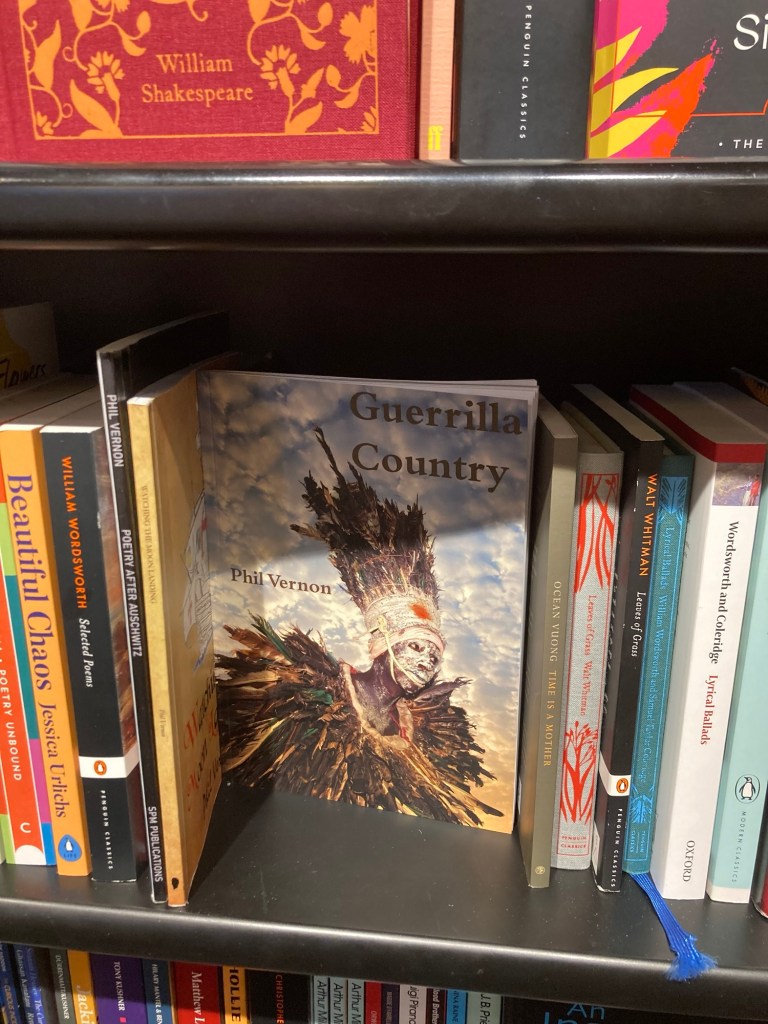
Guerrilla Country – My New Poetry Collection
Guerrilla Country – my new poetry collection – out today
I’m very happy to say that my third poetry collection Guerrilla Country is published today, and can be purchased from the publishers Flight of the Dragonfly Press. The poems explore the relationship between peace, conflict and place. The book is dedicated to current and past staff and collaborators of peacebuilding organisation International Alert, whose Executive Director Nic Hailey has kindly written an introduction.
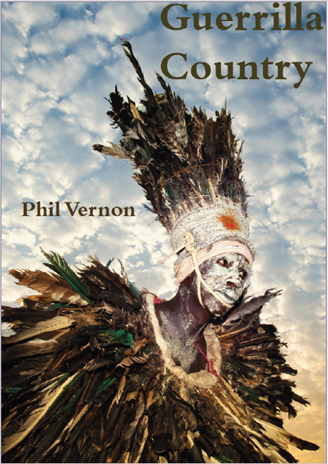
The book’s stunning cover is based on a photograph by Jonathan Banks. Jonathan kindly allowed us to use his picture of a dancer at the Peace and Culture Festival organised by International Alert in Liberia in 2008, celebrating Unity in Diversity as part of Liberia’s post-conflict recovery.
I worked for International Alert for more than a decade, and other NGOs before that. Guerrilla Country is partly my personal response to witnessing and trying to understand how conflict evolves into peace and how this process can be helped; as well as how fragile or seemingly stable situations so often revert or degenerate into violence.
The poems reflect on events in almost 40 different contexts, past and present, from Texas to Rwanda, via Afghanistan, Amristar, Belfast, Ukraine, Runnymede and Peterloo. I’m hoping the poems will be of interest, not just to the usual poetry audience, but also those involved in peacebuilding.
Here’s a small taste:
The King's Peace

To keep his peace, our king built temples,
courts and palaces, and scarred
the land he'd won, with ditches, ports
and roads; determined how we die;
and blessed us with his enmities.

To teach us irony, he named
his cousins lords and justices.
Apprised of God's mistake by priests
and clerks, on pain of punishment
he made us speak a single tongue.

His word was written, maps were drawn.
But laws and maps and roadways lengthened
distances, and when he sailed,
he left no instrument through which
to see, but a kaleidoscope.

We turn and turn its wheels, but cannot
make the fractured picture whole.
Choosing the score

They sought a music to
replace D major,
kettledrums and brass;
a music ending on
a quiet, sustained
C major tutti chord.

But the scores they chose
were beyond their grasp

or opened a hidden door.
Comments on the book by other poets
Raine Geoghegan
These are stirring poems with strong themes of war, hardship, freedom and renewal. Vernon writes from the perspective of both witness and peacebuilder. He illustrates the many complexities of war and conflict and through this lens the reader begins to glimpse both the harshness of war but also the beauty of peace. His observations are clear, concise and they take us on a road which he has clearly travelled. The poet and the peacebuilder are present in each poem. From the powerful imagery in The AK47 – my perfect design, ‘I run towards the gunfire, but/ I have no gun to love and hold’, to the poignant words in Aminata’s song, ‘My brothers, we challenge you now/ to gather your cousins and friends/ know how to stand your ground/ and when and how to bend.’ This is a brilliant collection. Go buy a copy.
Jack Caradoc
Guerilla Country is a far-reaching book in scope and complexity. A record, a journal of humanity in conflict. Vernon’s poetically sharp eye presents the terrible actualities both historically and in the political present, inviting us to consider often horror in our world but also the vital need for hope in the face of it. The light of poetry illuminating the darkest places as it should. Powerful words.
Susan Wicks
Guerrilla Country is a courageous book, with poems inspired by a wide geography of contemporary and historical battles – all the braver for its structure, which juxtaposes distant unnamed scenarios of conflict with some of the landscapes of deprivation that must have made them inevitable. We glimpse the forms and colours of medieval pageantry, and its aftermath. We see the patterns Kitchener left in the sand at Khartoum. And we hear Aminata’s song of stolen herds and hunger in a home with ‘no okra sauce’. Follow the clues to find yourself in a place of huge empathy, where war may be the shared language but measured thought and humanity still prevail.
Jess Mookherjee
The reader of Phil Vernon’s carefully wrought poems of witness in Guerrilla Country will meet displaced people and danger, and will run into gunfire. And yet nature persists, and through the passage of time and verse we also meet a kind of peace.
Reclamation
Reclamation

I. Tea Plantation

The pickers have long fled south, to bivouacs
that drip with cold; the geometry of tea
subverted where muhuti and flame trees
break cover, watching over weeds and vines.

Hyrax scurry from their burrows. Leopards
have returned to where they never knew.
Cranes circle high above the miracle
of sunbirds drawing nectar, motionless,
from coral and jewels they’d never have found before.

Black kites regard the rebel bands in tired
fatigues and rubber shoes, who thread their quiet
patrols on paths they’ve reimposed on the faintest
traces of a matrix overgrown.


II. Seat of power

And far away, where warlords feasted long
ago, and made their will known to the men
they charged to make it so—and where a king
was killed—the broken masonry is mocked

by oak and birch. A cenotaph’s obscured
by briars among which feral goats and cattle
browse—and dogs in sunken doorways wait
in ambush to reduce those herds to blood
and bones they’ll bare their teeth and battle for.

The dogs are watched in turn from shadowed vantage
points by scouts who’ve travelled from their sundered
homes across a narrow, hostile sea
in search of knowledge of what happened here,
to send back to their camps among the dunes.
This poem was included in Kent & Sussex Folio #76 in 2022. It is part of what I hope will be published as a new collection, of poems exploring the interactions between conflict, peace and place: Guerrilla Country.
(The Muhuti tree is Erythrina abysynica)
 Phil Vernon