Skip to content

Is peacebuilding just good development?

February 9, 2018

When writing International Alert’s report Redressing the balance last year, I shared the draft with colleagues for comments. When one colleague returned it, one of her main comments was that the report needed to say more clearly that peacebuilding is “just good development” in fragile and conflict-affected places.

This rang a bell for me. When I’d joined Alert back in 2004, peacebuilding was still a relatively distant cousin in the international development family, and many of my new colleagues were fiercely protective of its special status. Some, I felt, were even a little precious and esoteric about it. Whereas I was of the view that we were largely applying familiar development programming interventions: dialogue, capacity-building and training, participatory research, advocacy, knowledge transfer, solidarity, supporting local activism, underlying causes analysis, institutional strengthening, and so on, but with a clear intent to improve cohesion and conflict resolution, rather than – for example – to reduce poverty or improve schooling, as in the mainstream development community whence I had lately come. Certainly our desired outcomes largely fell under the same broad headings of changes in knowledge and awareness, and in individual and institutional behaviour.

Indeed, I remember writing an article then, for publication in a now-defunct journal, which argued that the human security and livelihood security frameworks – then both still in vogue – were almost the same, in that both took the individual citizen’s perspective as the starting point for trying to understand what needed to change in order to increase resilience, but applied a holistic and structure-based analytical framework to map opportunities and obstacles.  Later I co-led the team that articulated Alert’s Programme Framework – its peacebuilding methodology – and we borrowed unashamedly from livelihood security ideas. So the peacebuilding and development projects were certainly related: cousins, perhaps, if not so distant after all.

A key difference between peacebuilding and development programming, it seemed, was not so much the issues one looked at through the analytical lens (governance, economic participation, services, relationships, security, justice, gender and so forth), but the reason one was looking in the first place. If the mainstream development project was looking for obstacles to, opportunities for and drivers of sustained welfare and economic improvement, peacebuilders were looking at obstacles to, opportunities for and drivers of sustained and peaceful coexistence. Of course, they found many of the same things to work on: good governance was beneficial – essential, in fact – for both; and while peace was good for development, development was also very good for peace.

So, are peacebuilding and development very close cousins, or are they in fact the same thing? I kind of agree with my colleague that peacebuilding is “just good development practice” in places where conflict and fragility are dominant issues, simply because there seems no moral or logical justification for not emphasising peace as the main desired impact in any concept of progress there. And progress, surely, is the most appropriate synonym in normal language, for that jaded and overused jargon word: development. Nevertheless, there are, it seems to me, three things which continue typically to mark out and differentiate peacebuilding approaches from development approaches:

  • Goals. When  the higher goal or aim is defined explicitly in terms of peace, this affects  programming choices. These may at first sight seem the same as development approaches. But there will be subtle differences. For example, a peacebuilding programme focused on economic development will promote the kind of economic development that reduces grievances, and increases good relationships, rather than merely one that improves the livelihoods of a particular set of people or aims to increase GDP.
  • Vision-based, vs problem-solving. If development programming is still typically based on articulating and then solving a given and well-comprehended problem – why girls are not attending school, for example – peacebuilding more often requires a vision-based approach. This is because, while there is common agreement on what peace looks, tastes, smells and feels like, less is known about how to reach it. Mainly because the history of peaceful places is disputed, and because the pathways to peace are not based on clear linear relationships between the many variables involved. Transforming conflict into peace is a wicked problem. Using a vision-based approach, peacebuilders may determine the outcomes  they seek  – perhaps  improved trust among people, or between people and those who govern them – and use tentative, iterative approaches which they regularly recalibrate, to do so. In other words, the type of approach appropriate to wicked problems. Not that development programming couldn’t – even shouldn’t – adopt this approach, but typically it does not.
  • Appreciative inquiry. If development is still focused on overcoming problems and obstacles, the better starting point for vision-based peacebuilding is rather appreciative inquiry: what peaceful mechanisms already exist, and how can they be reinforced?

There is no reason for mainstream development activists not to follow these same approaches. But typically, they don’t. If my colleague and I are right that peacebuilding is “just good development” in conflict-affected and fragile places, then I’d argue that in such places, they should.

Ethical challenges facing mining companies?

February 5, 2018

Last week a friend who knows I have spent a fair amount of time working on mining/oil and with mining/oil companies in recent years asked me what are some of the major societal challenges facing mining companies in the next few years. My response to her question led me to write this blog post. I should say that much of what I’ve written is informed and borrowed from what I’ve heard others say. So little of this represents my own original thinking. I thought of five responses to her question.

Fairness/unfairness
In the background is the question which is often wrongly diagnosed as one of trust: a lack of trust in mining companies (along with other institutions, to be sure.) This interpretation seems like a classic example of transactional miners interpreting the problem through the lens of their own interest, as in: “we need the public’s trust, to be able to make money, so how can we restore it?” Just another version of the old, ought-to-be-discredited Social Licence to Operate idea.

Of course there is a trust deficit, but why, and what is the bigger issue? Fairness is a more useful lens to use. Whether you look locally, sub-nationally, nationally or internationally, there is a real problem of seemingly growing inequality – not just inequality of income, but inequality of wealth and opportunity.

People can live with a lot of inequality. It’s normal. What gets people’s goat is not having less, but unfairly having not enough – the idea that they or their people are not getting a fair slice – and in the worst case, losing their dignity. Increasingly people are driven by a frustration that they are being treated unfairly. They can see it first hand when they compare their circumstances with others nearby. And they can see on their phones and tv screens how much better off are others who have no more right to opportunity than they. And they (rightly) blame the institutions for that. Mining companies are not only institutions in their own right, but they are a fundamental and influential part of the institutional rules of the game which are manifestly unfair in people’s eyes – a key feature of the institutions whose success appears to be predicated on maintaining an unfair status quo.

There is no simple answer to this. Indeed, it’s part of what’s sometimes known as a ‘wicked problem‘ – one which defies accurate description, is hard to problemetise, let alone solve. But a key to addressing and unlocking this issue – which is part of a set of wicked problems linked to politics, demography, climate change, history, education, governance, luck, etc – is at least to recognise it.

Corporate citizenship – a common stake
This then is the background against which to consider the role of mining companies as corporate citizens. Citizenship can be defined by the nature of a person’s relations with his/her fellow citizens, and with the state. Companies wishing to be good corporate citizens – as they should, and as many already claim they are – therefore need to consider their relationship with fellow citizens. First and foremost, companies need to move away from seeing others as “their stakeholders”, towards seeing them as “fellow stakeholders”: fellows with a common stake in a future which is prosperous and sustainable in terms of the environment, society, health, security, justice, etc. This is a major shift for mining companies, who still tend to see others in transactional terms: what do I need to do for you, so you’ll do what I need you to do for me….

Secondly, the point about the relationship with the state. What does a good citizen do, vis a vis the state? S/he abides by the law, helps out, and contributes to sustainable progress in society. But in liberal democracies in particular, s/he also votes, pays taxes, and desires, campaigns, and lobbies for good government policies: not just government policies which affect his or her immediate interests, but those in line with his or her interpretation of society more broadly. And s/he holds government to account. So enlightened mining companies – which are often among the largest sources of government revenue, and around 40% across Africa – should presumably be taking steps to consult with others and determine what ‘good government policy and investment’ looks like in their operating environments, and using their considerable skills and access to lobby for those. This takes companies out of their comfort zone, but following one’s values and principles often does that, no?

The fiscal element is particularly important here because – as Paul Collier has written – mining royalties represent drawing down the capital or the patrimony of society, and they can only be drawn down once. Collier’s idea, I think, was they should therefore be treated as a special capital fund and only used for capital investment: i.e. an investment in making a better future. That means it’s even more essential that they are spent on only the best ideas, arrived at through only the best, well-informed consultation processes.

Of course its wrong to recommend that giant mining companies should have a voice commensurate with the revenues they remit: that’s a recipe for bad policy, and anyway, a citizen only has one vote. Exercising this citizen role requires a careful approach. But – recognising that there is no monopoly on good ideas, much less the right idea – maybe one of the ways for miners to contribute would be to use their sophistication and wealth and access to support and facilitate well informed consultation processes to help other citizens make up their minds; fund eclectic social policy think tanks, and so on …..

Fragile states
There’s a particular issue for companies operating in fragile or conflict-affected countries, where abudant sources of minable minerals seem to lie. Governance is inadequate there, and the minerals sector is frequently linked to instability, corruption and conflict. Yet natural resources governance is seldom addressed directly in civil war peace agreements – hence the problems recur. This is a major area for companies – especiallty the better companies – take responsibility for helping address. Another very “wicked problem”.

Kramer’s and Porter’s ‘shared value’ concept is the idea of “Policies and operating practices that enhance the competitiveness of a company while simultaneously advancing the economic and social conditions in the communities in which it operates. Shared value creation focuses on identifying and expanding the connections between societal and economic progress.” (M. E. Porter and M. R. Kramer, Creating shared value, Harvard Business Review, 2011). Surely in a fragile state, “social progress” includes – indeed substantially means – reducing the risk of conflict. So mining companies, as corporate citizens who believe in shared value, have to ask, how can they explicitly invest in progress towards peace? (I touched on this question at a much broader level in a published report in 2015: Peace through prosperity.)

Stewardship
There is increasing (legal and moral) recognition that the supply chain is part of the company’s zone of responsibility – for human rights, for example. But downstream also matters. E.g. to me, a mining company should not sell Uranium to nuclear industries operating in societies without a culture of transparency and challenge. We saw what happened in Japan with the Tsunami. Who knows what the scenario would have been in a more open society, but we can say there’s a good chance that safety planning would have been better if there had been a culture of openness and challenge in the sector – something conspicuously absent in nuclear industry in Japan, where even politicians were kept at bay. Uranium is relatively easy to consider in this respect. Quantities are small, and it is anyway subject to extremely detailed and pervasive international tracking systems.

It’s much harder to consider downstream stewardship when we think about the kinds of materials which are commoditised, but surely staff and shareholders of a mining company should at least want to know if the materials they sell are being used – for example – to make weapons, or build torture prisons, or build shopping malls or bridges or schools, and know how they feel about it, as a first ethical step. Coal of course brings another dimension to this story, in an era of dangerous pollution and climate change …..

Automation
Finally, ever since a mining company proudly played me its cartoon video of the fully automated mine, about 5 years ago – a scenario which it and other companies continue to work towards – I have been worried about this. How do you “sit” within society, when your wealth is being created by digging and exporting raw materials elsewhere without even providing many jobs? I don’t know the answer but it will have an impact on the “corporate citizenship” issue above… especially in fragile places….

_____

I’ve written before on this blog about the importance that companies with an inherently long view of things take their responsibilities very seriously. When you think about it, the major institutions in society are failing structurally to take a long view: democratic governments because voters don’t ask them to; undemocratic governments because their main interest is maintaining power for its own sake; most companies because neither consumers nor their all-too-fleeting shjareholders care enough to ask them to; and the major religious institutions frequently seem more interested in either the life hereafter or compliance with very specific individual and family norms and behaviours. So – strangely, perhaps – we must look to the insurance companies, pension funds and natural resources companies – especially forestry and mining who almost by definition have a long term stake – to take their leadership seriously.

The root causes of what? How root causes analysis can get in the way of peacebuilding

January 23, 2018

Peacebuilders often say we need to address the root causes of conflict, rather than just the symptoms. They are right, of course. Treating only the symptoms means conflicts remain unresolved, and violence will likely recur. But the language of root causes, while useful – essential, even – if wielded well, can also be unhelpful and misleading.

Root causes analysis has its origins in the field of transport safety and accident investigation. This makes good sense as there is no point finding road accidents are caused by inattentive truck drivers if their inattentiveness is due to weariness resulting from unsafe shift patterns, poor recruitment techniques, or unergonomic lorry cabs. These root causes can be addressed relatively easily, and clearly have the potential to deliver safety improvements. But in conflict and peacebuilding analysis, identifying the root causes of conflict can sometimes lead us too far away from what can readily be addressed.

It is of course essential for peacebuilders to understand the underlying causes of conflict as best they can. Otherwise they’ll have an incomplete picture of things, and may inadvertently make things worse by reinforcing a conflict cause they had not seen or understood. A conflict between two ethnic groups may seem on the surface to be about identity, when in fact it is at an underlying level about access to land and economic opportunity. Knowing that, allows peacebuilders to engage members of both ethnic groups in developing solutions geared to improving their access to economic opportunity, and thus potentially contribute to a sustainable peace by removing one of the underlying causes of the conflict, and allowing both sides to meet their needs and aspirations, without undermining those of the other side.

Things are always more complex than that, and understanding the web of underlying causes can not only help third parties identify possible solutions, it can also be a useful participatory peacebuilding technique. Engaging the conflict parties themselves in a careful exercise to describe the web of interconnected root causes of their conflict, can help them take a step back from their own assumptions about what is at stake, see that the picture is more complex – and sometimes identify common purpose with the other side, they might not otherwise have been able to articulate so readily.

How deeply should we dig?
But there are two ways in which I’ve seen root causes analysis can get in the way: by identifying insoluble problems, and thus unwittingly creating an idea that peaceful solutions aren’t possible, hence reinvigorating the call for violence; and by reinforcing a skewed framing of the problem.

In an example of the first issue, the root causes of the various ongoing conflicts in the middle east, include unresolved historical injustice, in some cases stretching back at least 1400 years, as well as more recent ones linked to the break-up of the Ottoman Empire, crass Franco-British colonialism, the Great Bitter Lake agreement, the creation of modern Israel, and so on. Knowing this is good, but root causes in history have already happened. They can’t be changed, so emphasising them can get in the way of more tractable issues, like for example understanding present day behaviours which impede trust, and working to reduce these.

The root causes of what?
Even more importantly, a focus on the causes of conflict tempts peacebuilders always to see conflict resolution – resolving or addressing the root causes of conflict – as their core goal. It guides them to frame the problematique in terms of unresolved conflicts with a complex web of causes, and the need to address and resolve those causes. That is certainly an important aspect of peacebuilding. But it needs to be allied with an arguably more sustainable approach, which frames the challenge in terms of the inadequate capacity to anticipate, manage, mitigate and resolve conflicts – or in the jargon, an insufficiency of Positive Peace. There will always be conflicts, so it is not enough to resolve the one most in evidence today as, without the capacity to anticipate and address new conflicts, the next one will surely come along to undermine stability again.

If the challenge is thus expressed in terms of insufficient capacity to anticipate, manage, mitigate and resolve conflicts, the search for underlying causes becomes the search for why this capacity is inadequate, and how it can be reinforced – rather than merely looking for the causes of today’s conflicts.

The root causes of the lack of positive peace
Positive peace is often expressed in terms of resilient, two-way relationships of trust among and between peoples, as well as between people and those they are governed by; and by fair access to economic opportunity, security, the means of justice, and other aspects of well-being such as health, education. This generic framework gives us a map we can use to identify where opportunities for strengthening positive peace may lie, by identifying the underlying causes of low levels of positive peace, and how these might be addressed.

The positive peace lens has other advantages. First, it takes people away from the perpetual examination of their conflicts, and provides an often welcome opportunity to embrace a different challenge. This is particularly helpful in long-lasting conflicts where the causes of the conflict – and, often, the demonization of the other side – have become normalised as simply part of the way the world is, and the prevalence of conflict analysis among thought leaders displaces peacebuilding analysis. This is what has happened in the South Caucasus for example, where the conflicts which were frozen by peace agreements in the 1990s remain unresolved, and a constant trope of politics and culture which impedes development.

Another advantage is that the positive peace framework is tremendously accessible, because it is built on the main preoccupations of politics and the development sector: welfare, economic development, governance, justice and security. This makes peacebuilding open to all, rather than the domain of a narrow field of expertise. The task of peacebuilders then becomes guiding others to maximise the degree to which their policies and programmes promote fairness, and thus undermine grievances, while building trusting relationships. To widen access to jobs and political voice, and ensure all citizens are safe and have access to a decent justice system, and can continue to meet their aspirations for improving their welfare and that of their families and communities.

In conclusion then, we need to know why conflicts happen, and this means understand the underlying, as well as the more obvious causes. And it is, of course, important to try and address these where possible. But it is also important to understand why the capacity of societies to anticipate, manage, mitigate and where possible resolve conflicts is below par, and prioritise steps to improve this, and thus strengthen positive peace. Something which the UN is focused on globally in 2018, through its Sustaining Peace agenda; and something to focus on nationally and locally, everywhere, for peace to increase and be sustained.

Magic dragons can’t build peace. Leaders can.

January 5, 2018

A central conceit of Nobel Prize winner Kazuo Ishiguro’s wise and beautifully crafted novel The Buried Giant (Faber and Faber, 2015) is that an uneasy peace between the Saxons who had migrated to the British Isles in the fifth and sixth centuries, and the British people they found there, was maintained as long as a magical dragon remained under the spell placed on it by Merlin, King Arthur’s court wizard. To say more would be to spoil the plot for future readers. But a common thread in the novel seems to be about the difficulties of coexisting peacefully, whether for an ageing married couple, within and between local communities, or between ethnic groups – and how magic dragons can help.

But peace is not the natural order of things, and can’t simply be switched on – by a magic spell or any other means. Violence all too often results when people compete over limited resources and power, or when they fear others have designs on the resources and power they hold. So peace has to be built – and then continually sustained, as there is always a risk it will be eroded. This applies to families, communities, countries and internationally.

Stepping down last month after over a decade as director of programmes at peacebuilding NGO International Alert, I reflected on what I’d learned about peacebuilding – an area of practice in which I’ve been involved since 1994, just two years after Boutros Boutros-Ghali set out his Agenda for Peace, an international vision for peacebuilding.


The complex ecology of peacebuilding

Peacebuilding as a discipline has been evolving apace since then. Much has been learned, and I think it’s fair to say that there’s considerable agreement that peace is more sustainable when people and peoples have functional, trusting relationships; transparent, fair and accessible mechanisms for making decisions which reflect all parties’ interests; and when they have fair access to economic opportunity, security, justice, education and the means to stay healthy and well. This way of framing peace permeates the peacebuilding sector, from the programming methodologies of NGOs like International Alert, to the Peacebuilding and Statebuilding Goals associated with the International Dialogue on Peacebuilding and Statebuilding and the New Deal for Building Peaceful States, to the UN’s current Sustaining Peace Agenda.

What’s less commonly agreed – not the least because it is less clearly established – is just how to build and sustain peace. There are a plethora of frameworks out there, providing practical guidance and/or setting out different sets of norms and principles: from Responding to Conflict’s essential  Working with Conflict, through sets of guidance linked to various religions, to Alert’s recent (and secular) Redressing the Balance report. All of these contain different takes on how to improve the prospects one’s own peace, help others improve theirs, or contribute to a wider global, mutual, shared peace. Most are probably mostly right, and taken together they reflect the reality that all of us can make a contribution to peace, therefore the methodologies and approaches need to reflect the different capacities, instruments and tools we each have or can aspire to. The complex ecology of peacebuilding, in which many valid and complementary niches co-exist.

I won’t attempt to improve or add to these. They all bring a useful addition to the body of accessible knowledge, and contribute to the understanding of how to make progress towards a peace which transcends the interests a particular, dominant group. But is there anything I’ve learned, that’s worth putting on record as I make my personal transition from long-term NGO employee to freelance consultant?

Alongside all the very useful knowledge and guidance about dialogue, training, conflict-sensitivity, gender, conflict-mapping, root causes analysis, political settlements, stabilisation frameworks, citizen-state relations, prosperity for peace, structural peace, connectors and dividers, political economy analysis, centre-periphery relations, post-conflict reintegration, peacebuilding pyramids, positive and negative peace, reconciliation, security sector reform, inner peace, conflict transformation, social orders … and all the merry rest (the list could go on and on), one thing above all stands out: the importance of leadership.


The order of things

Renaissance writer Niccolò Machiavelli wrote in The Prince, his book on governance, that ‘there is nothing more difficult to take in hand, more perilous to conduct, or more uncertain in its success, than to take the lead in the introduction of a new order of things’. To that, I would add that at times, the peril and difficulty comes from trying to prevent a negative change in the order of things. In either case, the point is that standing against the tide takes a combination of vision, courage, practical ideas about how to proceed, and the ability to inspire others: in a word, leadership.

Many years ago, I took part in a meeting to discuss how a group of NGOs might contribute to peace in Northern Uganda, where for year after endless year, up to a million people had been held hostage by the conflict between the government and the Lord’s Resistance Army (LRA). Our discussion was underpinned by our common frustration that for years, we had been able to do little more than provide inadequate services to people stuck in concentration camps, while the war continued to undermine their livelihoods, and taint or terminate their lives.

We were making little real progress in our well-meaning debate, until my neighbour – a humble man I did not until then know well – stood up, brusquely interrupted proceedings, and told us that we were wasting our time. “Until we are able to discuss the real causes of this war, and talk honestly about finding political solutions to the issues which have caused it, we won’t change a thing”, he said. His own daughter had been abducted by the LRA, so he had a very personal stake. And he was right: we were – albeit for understandable reasons – swimming with the tide by avoiding some of the difficult political issues until he spoke up. His  intervention stopped us in our tracks, and from that pivotal moment the discussion took a more useful turn. His intervention led to the formation of an advocacy group – Civil Society for Peace in Northern Uganda – which I am convinced made a significant contribution, through its advocacy with political leaders, thought leaders and members of the international community, to bringing that conflict to an end. Leadership.

During my time at Alert, I’ve had the privilege of meeting and working with many others who, like my neighbour at that meeting in Uganda more than fifteen years ago, have stood their ground to make a change happen – or prevent a bad change from happening – in the order of things. Some were Alert colleagues, others Alert’s collaborators and partners. Not all of them exercised their leadership in the classic, leading-from-the-front way: indeed, some were happy to play a quieter leadership role. I will not embarrass them by naming them here, but it is actions such as theirs, underpinned by courage, vision and ideas, which make the world fairer and more peaceful, brick by painstaking brick.

Some have stood up for the moderate, middle ground – and risked having both extremes unite against them. Others have stood up for the rights of women, or particular social groups, to be accorded the dignity afforded to others, and to have a say in their future and a say in how to create that future. Some have acted very locally, while others have worked on a broader national or international canvas. Some have found new, creative ways to frame the context and show where the opportunities for change lie. Some have focused their attention more on people than ideas, while others have done the opposite. I have seen some hang their heads in tired defeat, exhausted, before recovering their energy and returning to the task, perhaps approaching it in a new way, learning from their previous experience. But they’ve all combined courage, vision and inspiration with an idea of how, practically, to move forward.

So if there’s a lesson for international agencies like International Alert from this, it’s that their role must surely be to continue trying to get to know and support the people – the leaders – who wish to bring about or prevent a change in the order of things, and thus contribute to making their world fairer and more peaceful. If there are any magic dragons out there, by all means let’s work with them too, but a key component in building peace is always, surely, going to be leadership.

Freedom zone

December 17, 2017

She pauses, lowers the blinds,
departs; the taxi pulls away;
she starts to leave herself behind;

sheds what her check-in baggage weighs,
the life her passport photo knows,
and layer by layer, herself decays,

dissolves, and then a new self grows,
holds court in the airport bar, portraying
an image drawn from movie roles.

The boarding pass still bears her name,
but unmoored, in the here and now
of transit, she can choose the game

and players, set the rules for how
they’ll play, and use her new-found flair
for risk to seize the winner’s crown.

The tannoy sounds. In striplight glare
the five-card poker hands she deals
are the columns and rows of solitaire.

Later she picks at her in-flight meal,
sobs silently at the film that’s shown,
at what the dark almost reveals:

to travel in this neither zone
simply unshackles her to feel
yet more detached, yet more alone.


Published in The Poetry Shed

Paying Respects

November 29, 2017

For Maurice


The quince you so admired each year

has blossomed – a flamenco show.

Your wallflowers have now appeared,

a golden frieze you will not know.


Your clock chimes through the party wall;

no other human sound disturbs

the creaks and phantom footfalls, nor

your silence, nor the garden birds.


You hated dark, and welcomed spring –

the chance to slough off solitude,

absorb the warmth of friends and sun.


I pray, by taking pleasure in

these sights and sounds that lifted you,

we know today as you’d have done.


Published in Pennine Platform, No 82, 2017

Does war have a future?

November 11, 2017

‘History is made by people who don’t know what is going to happen next’. With this truism – a truism we too often forget, whether thinking about our own future history, or trying to interpret the past – Lawrence Freedman introduces his wide ranging and literate analysis of how commentators, experts and society at large over the past 150 years have envisaged and prepared for war and peace, and how they have all too often got it wrong: The Future of War – A History.

From the mid 19th century to today, we have all too often misunderstood how and when war would happen, and how it would play out, whether in understanding how what became the Great War would be precipitated and why – to this day people argue about its causes – whether Nato and the Warsaw Pact forces would fight, how post-colonial polities would resolve their inevitable conflicts, how great civilisations might ‘clash’, …. And no-one seemed more surprised at how the Cold War ended, than those who were paid to monitor its progress. Not a great track record.

Freedman quotes Hannah Arendt who claimed that ‘predictions .. are never anything but projections of the present automatic processes and procedures, that is, of occurrences that are likely to come to pass if men do not act and if nothing unexpected happens; every action, for better or worse, and every accident necessarily destroys the whole pattern in whose frame the prediction moves and where it finds it evidence.’ So trying to map the future is a mug’s game.

Nevertheless, people are paid or otherwise motivated to do it. In line with Arendt, what this book shows, in its analysis of how future conflicts were and are framed and planned for, is that our perceptions and predictions of tomorrow are routinely shaped by the ideology and underlying values which shape our view of today – as well as by the genuine difficulty of understanding the complex phenomena and trends which might lead to war and violence. Realism, pacifism, idealism, populism, nationalism, racism – and a whole host of -isms – place lenses before our eyes which distort our view of what may come to pass. A fascinating example of this can be seen in the way some writers of the modern, digital age, have come to believe that they can develop algorithms which predict how people with certain profiles will be drawn into joining violent extremist groups – no doubt reflecting our present-day fascination with automated knowledge.

The Future of War is well worth reading, especially for the non-expert, as its middle section is a kind of tapestry of all the different kinds of conflict which have been going on since the end of the Cold War. So, a useful summary of the turbulence of our era. It has become routine to say that modern day conflicts are increasingly fragmented, interconnected and intractable, and the book reflects this. It pretty much rejects the various attempts which have been made to bring a ‘scientific’ analytical lens to the study and understanding of how wars happen. Such methods don’t seem to have added much to the understanding we had before, imperfect as that has always been. Wars – and the politics and geopolitics they reflect – are so multi-faceted, it is hard to explain them usefully in a scientific way. Just try transposing the constantly evolving Syrian conflict(s) into the straitjacket of a database, if you want to test this.

Perhaps on some level, it’s encouraging that we are still making history without knowing what is going to happen next – despite the valiant attempts of think tanks to predict societal processes and outcomes. This also has lessons for peacebuilding and other social change endeavours: just as it’s hard to predict the onset and character of conflicts accurately, we should be wary of claiming to know how well-meaning actions designed to promote peaceful co-existence within and between societies will actually work out.

Nevertheless, I think Freedman’s analysis bears out the idea that, even if we can’t predict how tomorrow – our future history – will be, we can at least see that there are a number of factors more associated with peace, than with war. And that these factors are also negatively correlated with the presence of violence within society (domestic violence, organised criminal gangs, and violent politics, for example).  So, even if we can’t control how peace evolves or is built, if we focus our attention on trying to strengthen these factors, we can be relatively confident that we’ll become better at redirecting human energy away from war, towards more positive forms of interaction and investment. The attributes which create this kind of resilience to conflict are imbued with the idea of fairness, and can be summarised as:

  • Good governance, and trusting, functional relationships among people and between peoples, and between people and their governments
  • Decent, fair opportunities for people and communities across and between different groups in society, to earn a livelihood
  • Fair access to the means of justice, and the means to stay safe from harm, and
  • Fair access to opportunities for education, health, a decent living environment, and to improve our families’ lives.

Fig 1 peace factors

These are what International Alert, in its Programming Framework, calls the Peace Factors. Even if we can’t predict and prevent all wars, if the global community, nations and local communities were to focus more of their attention on strengthening these attributes of resilience to violent conflict, we’d be heading in the right direction, and the Future of War would be a declining one. Not a bad way to think, today, of all days: 11th November, the anniversary of the Armistice signed at the end of the Great War in 1918 – after millions of people had died.

Ten things MPs need to know and ask about peacebuilding

November 10, 2017
International Alert recently published Redressing the Balance: why we need more peacebuilding in an increasingly uncertain world. This makes the case for a greater focus on and more resources to be invested in peacebuilding, to increase stability and help improve people’s lives in conflict-affected countries around the world.

As part of a series of recommendations in the report, we have called on members of parliament in donor countries to put more emphasis on peacebuilding. With this in mind, here are five things MPs on the UK’s International Development Committee, and their counterparts in other parliaments and the US Congress need to know, along with five questions they ought to ask as part of their scrutiny.

Five things MPs need to know: 

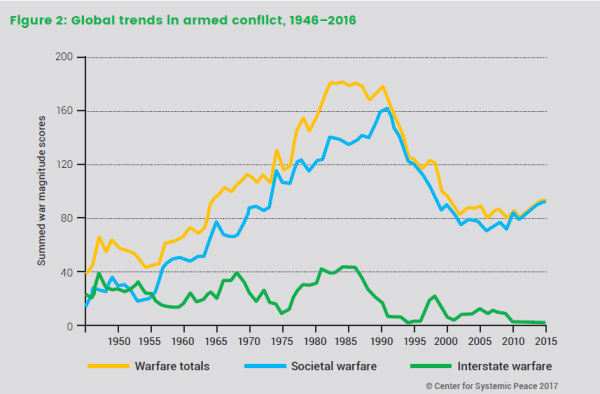
1. Conflict is on the rise again. After a steady decline in conflict since the end of the cold war, the number of wars has increased from 31 to 40 since 2010. The accompanying graph from the Center for Systemic Peace (figure 2 from our report) shows this trend graphically, based on their index of “war magnitude”. Meantime, the number of battle deaths has tripled since 2003, and went up by 27% in 2016 alone. That so much of today’s conflict is focused in the Middle East and Afghanistan, while other parts of the world seem to be more peaceful, should not make anyone complacent, as conflict crosses borders all too easily, as demonstrated by violent extremist acts taking place across the world.

Fig 2

2. Peacebuilding works, provided it is sustained. Building sustainable peace is a long-term endeavour, as any student of history knows. That puts off some decision makers, who are keen to show rapid, tangible results. But evidence from across the world – a sample of which we included in our report – clearly demonstrates how peacebuilding interventions make a timely, tangible and measurable change in people’s lives, their ability to live more securely, resolve their differences, grow the economy, and meet their aspirations in ways which allow others to do the same. The report shows how levels of trust were increased between warring Christian and Muslim communities in the Central African Republic; conflict resolution was improved in the Democratic Republic of Congo, Guatemala and Indonesia; political parties in Lebanon became more collaborative; and Serbian leaders intervened to stop revenge attacks on Albanians in Kosovo, in which they admitted they might previously have taken part themselves. It also features the work of business leaders who helped consolidate peace in Northern Uganda; Burundian activists preventing local political violence; security operatives changing their approaches so as to reduce the risk of violence in the Philippines, Afghanistan and Israel-Palestine; and Sudanese women using the mechanisms their mothers had taught them for taunting men to go to war, to persuade community leaders to push for peace instead. And it shows how a variety of mutually supportive peacebuilding initiatives had embedded peaceful attitudes, behaviours and systems in places as diverse as Northern Ireland, Nepal and South Africa.

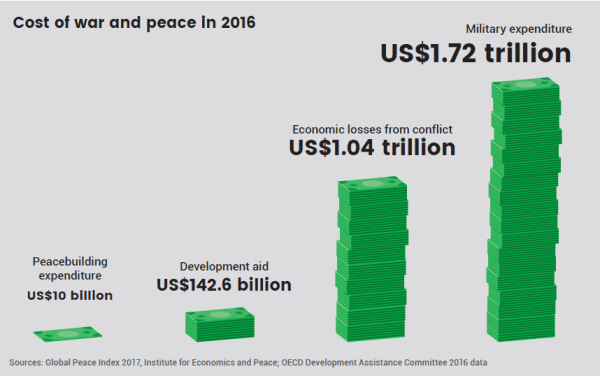
3. Not nearly enough is being spent on peacebuilding. The policy rhetoric has embraced peacebuilding in the past few years. From the UK Government’s aid programme, the internationally adopted Sustainable Development Goals, the European Union, the World Bank and the UN, to name just a few, policy makers and policies are replete with the language of peacebuilding. And yet, this has not been put into practice on anything like the scale the policies imply, and the needs of peace demand. A recent paper from the Institute for Economics and Peace estimated that the value of peacebuilding investment is only worth about 0.5% of the US$ 1.72 trillion spent globally on the military, and less than 1% of the annual US$ 1.04 trillion cost of lost economic growth due to war. And yet, the same organisation has also demonstrated that every dollar invested in peacebuilding yields sixteen dollars in savings due reduced conflict. So peacebuilding not only works, but is also cost effective – and helps reduce the risk of violent extremism at home, as well as the pain and suffering caused to vulnerable communities far away.

The money piles

4. There is an enormous potential to weave peacebuilding into other forms of engagement: development, diplomacy, trade, etc. Peacebuilding is not something which can be done in isolation, and it can easily be – and should be – integrated into other international initiatives: development aid, diplomacy and so on. In one example, many businesses in Colombia have sought to contribute to the peace process there by their public statements, and also by seeking to support the process of reintegration and reconciliation by workplace initiatives. Meanwhile, it is well known that international initiatives to prevent terrorism are most effective when they rely not just on policing and other traditional security operations, but they also use peacebuilding approaches to reduce tensions and increase the sense of inclusion in the societies where terrorists have typically been recruited.

5. There is a ready-made political constituency willing to back political leaders who champion peacebuilding. This has been demonstrated by polling data recently published by Conciliation Resources and The Alliance for Peacebuilding, which shows that over 70% of people in the UK, the USA and Germany believe peacebuilding is vital, and at least 60% also felt that investment in peacebuilding should be increased, as a both moral and political imperative.

Five questions MPs need to ask: 

​1. Is enough money and effort going into peacebuilding? The Institute for Economics and Peace estimates that peacebuilding expenditure in conflict-affected places needs to be worth at least $27 per capita, for a critical mass of change to occur, but is currently only half that.

2. Are government interventions in conflict-affected places focused on building peace and reducing fragility; are they focused not only on short-term stability and security, but also on long-term durable security, engineered through deep and wide political and economic inclusion? It is all too easy to fall into the trap of supporting short term arrangements which help create the stability needed to end or avoid violence, and then turn into repressive and non-inclusive political arrangements which harm their citizens and create grievances which later foment violence. The excitement of the Arab Spring has given way to a military dictatorship in Egypt which is as bad if not worse than the Mubarak regime the Arab Spring brought down. It’s critical that international support for stabilisation integrates support for the development of increasingly inclusive political economy which highlights tolerance, fairness and the inclusion pf women, men and people of all ages and identity groups. Are development and humanitarian programmes in fragile and conflict affected places being designed so they integrate elements of peacebuilding – as they can all too easily be?

3. Are peace activities being sustained for long enough to make a real difference to durable peace? It takes decades to build the foundations for sustainable peace, so it is important that peacebuilding remains a central goal of initiatives, long after the violence which first inspired them may have subsided. And yet all too often, the need for peacebuilding is forgotten as other, familiar tropes take centre stage: economic growth, infrastructure, and so on. It’s critical that providers of international aid focus their support to fragile or conflict affected countries on the need to reduce fragility and embed sustainable peace, for at least twenty-five years after the last fighting ended. After all, at least one third of peace agreements still fail to hold.

4. Are decision makers in government departments and the multilaterals they fund, sufficiently aware of the peacebuilding options available to them or otherwise active in accessing relevant advice? One of the obstacles to peacebuilding is that politicians and officials tend to support initiatives with they are already familiar: health, education and livelihoods aid programmes; military and security initiatives, etc. An important question to ask ministers facing parliamentary inquiries is: what do they know of peacebuilding methods, and what do their key advisors and decision-makers know?

5. Are international organisations being supported to work in fragile/conflict-affected places, sufficiently skilled in peacebuilding? Huge budgets are allocated to intergovernmental organisations: the UN and its various departments; the World Bank and its regional sister organisations, etc. Much of this money is spent in fragile and conflict-affected states. Are such organisation directing these resources to peacebuilding, and do they have the knowledge and skills to do so?


Glimpse

November 10, 2017

Throughout your life, you suffered prejudice:

a look, a word, the absence of a word,

led you to add offenders to your list –

though what they’d said was seldom what you’d heard.


And yet to those who knew their place, and yours,

as I did naturally, you shone so bright

we basked, and took for granted the applause

accorded – sought by – you was yours by right.


When your candescence died before you did,

if you knew us, or you, you gave no sign;

we prayed you weren’t aware of how you lived –

the helplessness, the odour of decline,


your not quite puzzled commentary and tone:

I knew you yesterday; don’t make that face;

my brother’s ship is due; is this my home?

And then withdrawal: an empty pupa case.


One morning like today, in spring’s chaste light

you drew me close – you knew me after all –

and whispered I went to the edge last night –

they held me back – they should have let me fall.


In that clear glimpse before the clouds closed in

again, your hopeless eyes told me you knew.

We kept your flame alight but faltering.

And now, I struggle to remember you.


Published in Pennine Platform, No. 82, 2017

Letting down

November 10, 2017

There are péchés véniels of letting down:

the dates and deadlines missed, the cards unsent,

implied commitments quietly disavowed,

and un-run errands; small forgettings. Then

the more important kind: the two men dead

because of things he failed to do; the pains

ignored, solicitations left unsaid:

his ceaseless failure to untangle shame

from guilt. You swam in swelling waters and

I looked away. You wandered unprepared

into the badlands; I could only stand

there as your voice grew ever fainter – scared

to act. You’re still not safe. I still can’t move.

I let down furthest, those I’m closest to.


Published in Pennine Platform, No.82, 2017